

Why Clean Power Matters in Modern Data Centers
Data centers form the backbone of today’s digital economy, supporting cloud computing, artificial intelligence, financial transactions, telecommunications, and essential digital services.
Behind every server rack lies an extensive electrical infrastructure designed to deliver dependable power and maintain suitable operating conditions.
Uninterruptible Power Supplies (UPS), power distribution systems, cooling equipment, and electronic converters all contribute to the operation of a modern data center.
However, these technologies can also introduce unwanted electrical disturbances.
As data centers expand and power densities increase, managing electromagnetic interference (EMI) becomes an important part of electrical system design.
NanoChokes nanocrystalline magnetic technology offers a potential approach to managing selected high-frequency electrical disturbances in data center infrastructure.
At Voxbourne Energy, our clean power approach focuses on supporting electromagnetic compatibility and electrical reliability through application-specific engineering solutions.
Understanding Electrical Noise in Data Center Infrastructure
Modern data centers contain numerous devices that convert and regulate electrical energy.
UPS systems use power electronics to maintain continuity of power to critical loads. Server power supplies convert incoming electrical energy into the regulated DC voltages required by computing equipment.
Meanwhile, Variable Frequency Drives (VFDs) control selected cooling motors, pumps, and fans.
These systems commonly rely on high-frequency semiconductor switching.
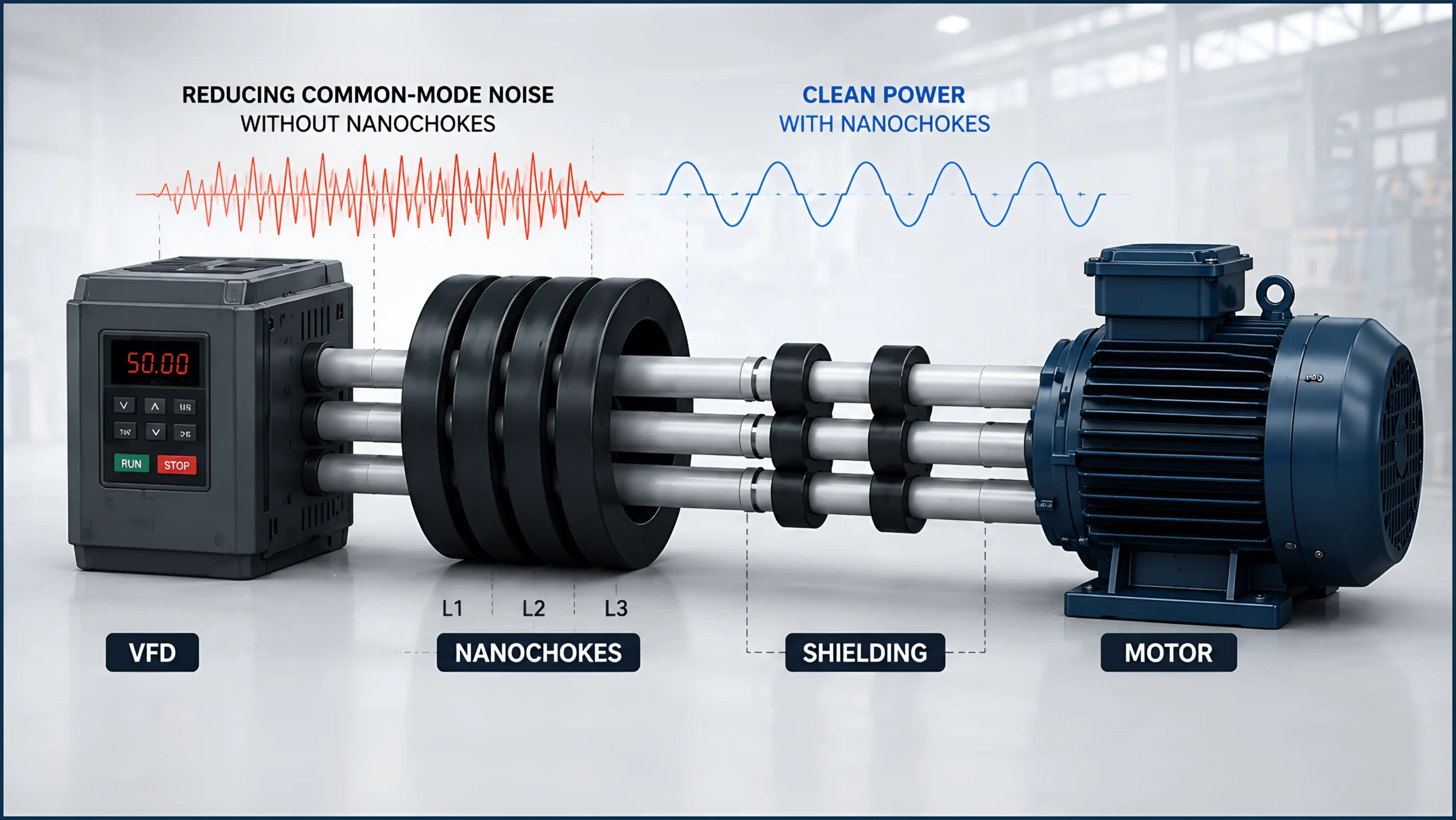
Rapid switching transitions can generate unwanted common-mode and differential-mode noise, depending on the equipment design and electrical installation.
Electrical disturbances may propagate through power conductors, grounding structures, and parasitic capacitances.
If not adequately managed, electromagnetic interference can complicate compatibility between interconnected electrical and electronic systems.
Proper equipment design, grounding, shielding, filtering, and installation practices help control these disturbances.
What Are NanoChokes and How Do They Work?
NanoChokes are magnetic choke solutions based on advanced nanocrystalline technology.
Nanocrystalline magnetic materials offer useful soft-magnetic properties, including high permeability under suitable operating conditions.
These properties make them attractive for certain high-frequency common-mode interference suppression applications.
A common-mode choke operates by introducing impedance to unwanted common-mode currents while allowing the intended operating current to flow.
In a properly designed multi-conductor choke, the magnetic effects of balanced operating currents largely cancel within the magnetic core.
Unwanted common-mode currents create a net magnetic effect and encounter additional impedance.
This can help limit selected high-frequency current components.
Differential-mode chokes operate differently. They introduce inductance into the intended current path to address selected differential-mode disturbances.
Common-mode and differential-mode chokes are not interchangeable, and their suitability depends on the actual circuit and interference characteristics.
Application 1: EMI Management in Data Center UPS Systems
UPS systems are essential components of data center electrical infrastructure.
They provide power continuity during specified supply disturbances and support the transition to backup energy sources.
Modern UPS equipment commonly incorporates rectifiers, inverters, DC-link circuits, and high-speed switching devices.
These power conversion stages can generate electromagnetic interference that must be addressed through appropriate equipment design.
Nanocrystalline common-mode chokes can be considered as magnetic components within suitable UPS EMI-filtering circuits.
Their role is to provide impedance to unwanted high-frequency common-mode currents.
However, integration requires careful consideration of electrical ratings, system topology, leakage current, thermal performance, and EMC requirements.
A choke should not be added to an existing UPS without manufacturer approval and appropriate engineering validation.
NanoChokes technology may therefore be relevant to UPS manufacturers and power-electronics engineers evaluating magnetic components for EMI-filter design.
Application 2: VFD-Driven Cooling Systems
Cooling is one of the most important supporting functions in data center operation.
Depending on the facility design, cooling infrastructure may include air-handling units, chilled-water pumps, cooling tower fans, and other motor-driven equipment.
VFDs are widely used to regulate motor speed according to cooling demand.
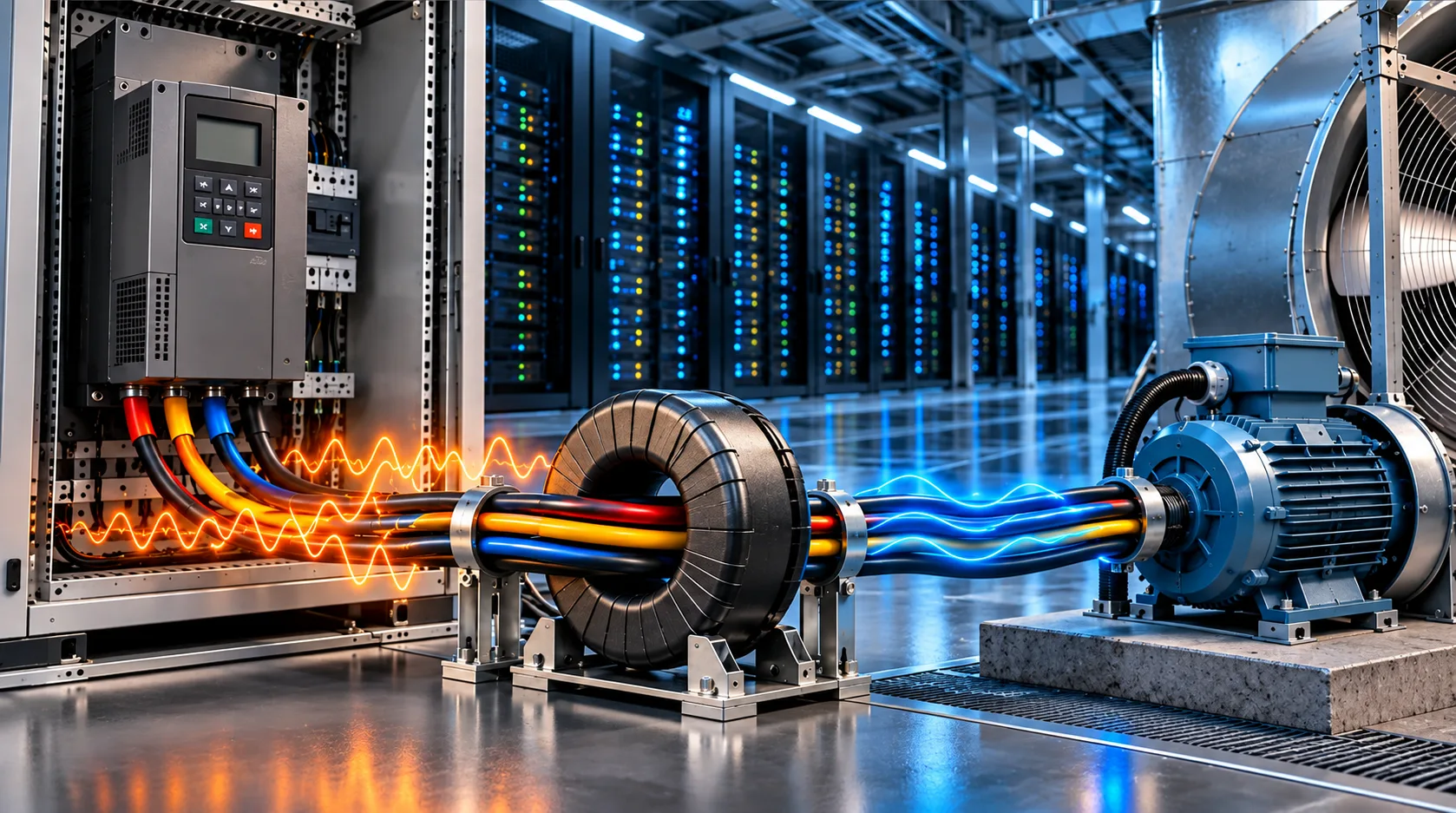
Although variable-speed operation offers control and potential efficiency advantages, the fast switching used by VFDs can generate high-frequency common-mode currents.
These currents may travel through motor cables, grounding conductors, motor frames, and associated structures.
Appropriately selected NanoChokes common-mode solutions may help attenuate selected unwanted currents within a properly engineered motor-drive system.
This can form part of a broader electromagnetic compatibility strategy involving cable shielding, bonding, grounding, and suitable output filtering.
Where electrical bearing-current problems are identified, additional motor protection measures may also be required.
The objective is targeted interference mitigation not a claim that common-mode chokes directly reduce cooling energy consumption.
Application 3: Power Conversion and Distribution Equipment
Data centers depend on power conversion equipment to distribute electrical energy to computing and infrastructure loads.
Switching power supplies, DC converters, and related systems require attention to conducted electromagnetic emissions.
Depending on circuit architecture and equipment requirements, common-mode and differential-mode magnetic components can contribute to EMI filter design.
Nanocrystalline magnetic technology may be suitable for certain applications where compact designs and useful common-mode impedance characteristics are required.
For equipment manufacturers, component selection should consider voltage ratings, operating current, impedance over the relevant frequency range, insulation, temperature rise, and mechanical integration.
NanoChokes may be evaluated for these requirements where supported by the specific product’s electrical characteristics.
Application 4: Supporting Electromagnetic Compatibility
Data centers contain sensitive electronic equipment, monitoring systems, network infrastructure, and automation controls.
Although these systems are engineered for demanding operating environments, electrical disturbances must still be managed to meet applicable EMC requirements.
Common-mode chokes can contribute to reducing conducted interference in suitable circuits.
Their effectiveness depends on the equipment design, the actual noise path, and the surrounding electrical network.
They should be considered alongside established EMC techniques such as appropriate filtering, shielding, cable routing, grounding, and bonding.
A complete system-level approach is especially important for critical infrastructure.
Why Nanocrystalline Magnetic Materials Are Relevant
Nanocrystalline materials can provide useful magnetic properties for EMI suppression applications.
In suitable designs, high permeability and frequency-dependent impedance characteristics may support effective common-mode choke operation.
However, material properties alone do not determine the performance of a finished component.
Actual results depend on core dimensions, winding or conductor configuration, operating frequency, current, temperature, magnetic bias, and system impedance.
For data center equipment manufacturers, these factors must be evaluated against the electrical requirements of the intended application.
The suitability of a particular NanoChokes model must therefore be established using verified product data and, where appropriate, application-level testing.
Selecting NanoChokes for Data Center Applications
Before evaluating a magnetic choke for data center infrastructure, engineers should identify the source and type of electrical interference.
Important considerations include:
For critical installations, any proposed modification should follow the equipment manufacturer’s requirements and an appropriate engineering review.
Where possible, before-and-after measurements should be performed to verify the intended attenuation without compromising equipment performance.
Clean Power and Data Center Sustainability
Clean power in data center infrastructure involves more than renewable electricity procurement.
It also includes electrical performance, electromagnetic compatibility, efficient equipment operation, and reliable power delivery.
NanoChokes primarily address selected electrical noise and interference challenges.
They are not electricity generation devices and should not be presented as solutions that automatically improve Power Usage Effectiveness (PUE), reduce facility energy consumption, or guarantee uptime.
However, mitigating genuine interference problems can contribute to a more robust electrical design and support equipment reliability.
This application-focused approach aligns with the broader objective of developing dependable and sustainable digital infrastructure.
Conclusion: Supporting the Next Generation of Data Center Infrastructure
As data centers evolve to support growing computing requirements, their electrical infrastructure must accommodate increasingly sophisticated power-electronic systems.
UPS equipment, cooling drives, converters, and power distribution systems all require careful electromagnetic compatibility engineering.
Nanocrystalline magnetic technologies provide valuable options for addressing selected high-frequency electrical disturbances.
At Voxbourne Energy, we see NanoChokes as a potential component of cleaner and more reliable data center electrical systems.
Through application-focused engineering, appropriate magnetic component selection, and technical validation, NanoChokes can support the development of advanced power-electronics and industrial infrastructure solutions.
Explore NanoChokes for your next data center power-electronics or cooling-system application.
Visit www.nanochokes.com and www.voxbourneenergy.com to learn more about our clean power technologies.
WhatsApp us