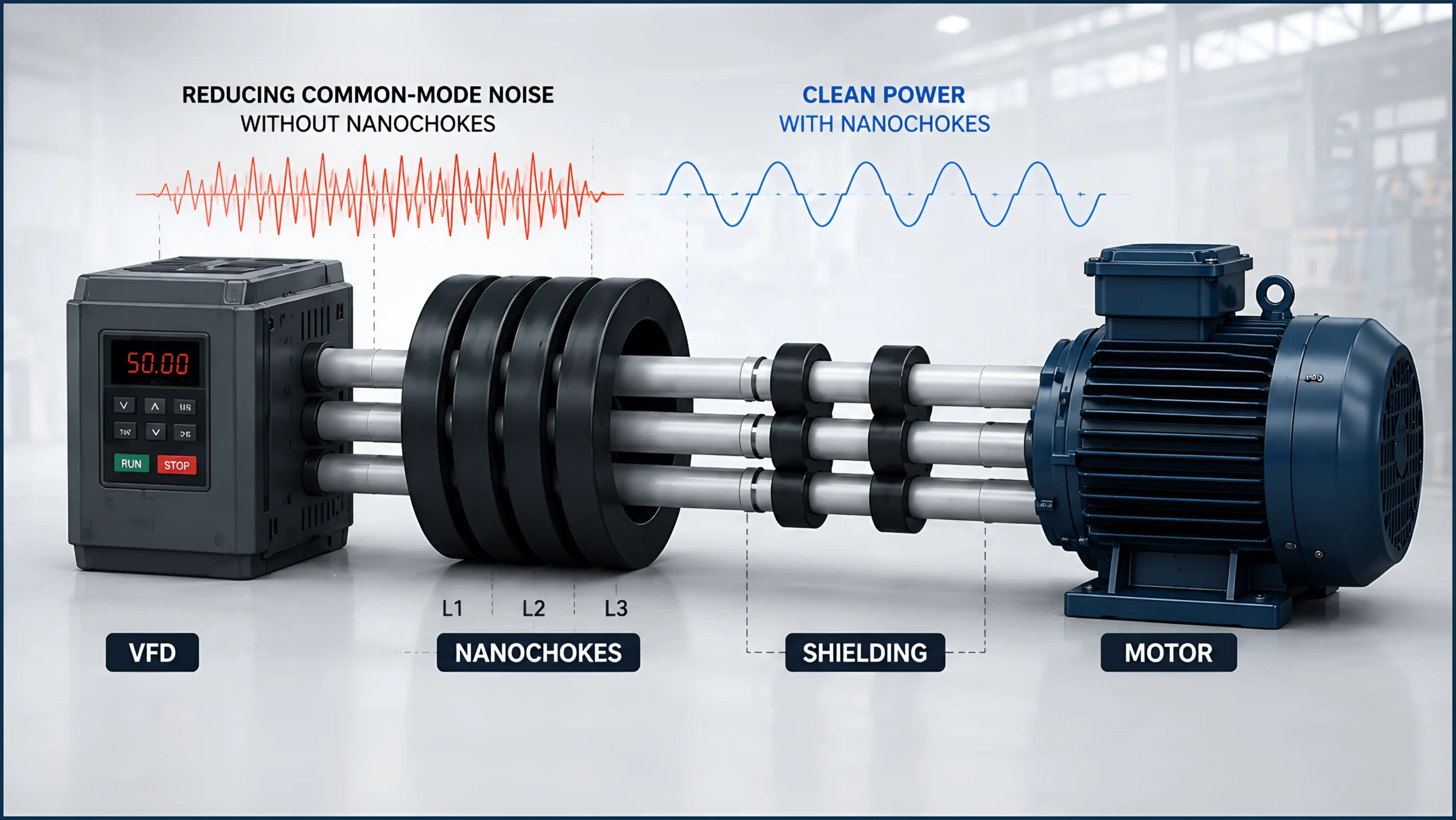


Conceptual illustration only – not an installation diagram or product photograph.
The hidden electrical challenge behind motor bearing failures
Industrial motors keep manufacturing plants, HVAC systems, water-treatment facilities and processing operations moving. Variable Frequency Drives (VFDs) offer precise motor control and, in suitable applications, improved energy efficiency. Yet their rapid switching can also introduce high-frequency electrical disturbances into the motor system.
One concern is unwanted shaft voltage and bearing current. Under certain conditions, electrical discharges across the lubricating film inside a motor bearing can damage its surfaces, increase vibration and contribute to premature failure. Simply replacing the bearing may not address the underlying electrical cause.
Why can VFDs create shaft voltage?
VFD power semiconductors switch rapidly to create a controlled motor voltage waveform. Fast voltage transitions interact with parasitic capacitances in motor windings, cables and grounded equipment, producing common-mode voltages and high-frequency currents. Depending on motor construction, cabling, grounding and bearing design, a voltage difference may develop between the rotating shaft and motor frame.
When the voltage across the bearing lubricant film becomes sufficiently high, a discharge can occur. Not every bearing current has the same origin: capacitive discharge currents, circulating currents and shaft-grounding currents may require different diagnostic and mitigation approaches.
How electrical currents can damage bearings
Shaft grounding: an alternative electrical path
A shaft grounding ring or brush creates conductive contact between the rotating shaft and the grounded motor structure. When appropriately selected and installed, this alternative path can help mitigate certain shaft-voltage and bearing-discharge mechanisms.
Performance depends on continuous contact, impedance at relevant frequencies, shaft surface condition, operating speed, contamination, mounting and maintenance. Shaft grounding is not a universal solution; some circulating-current mechanisms may also require insulated bearings or broader installation changes.
How NanoChokes can complement shaft grounding
Shaft grounding addresses selected discharge conditions at the shaft. NanoChokes nanocrystalline common-mode choke solutions address a different part of the challenge: applicable high-frequency common-mode currents associated with switching power electronics.
In a properly designed three-phase common-mode choke, magnetic flux from balanced operating currents largely cancels in the core. Unwanted common-mode currents create a net magnetic effect and encounter added impedance. Actual attenuation depends on the selected choke, operating current, frequency and surrounding electrical circuit.
These technologies are complementary in concept, not interchangeable. A motor system may require shaft grounding, common-mode filtering, bearing insulation, cable-shielding improvements or a combination, depending on the diagnosed mechanism.
| Shaft grounding | NanoChokes common-mode choke |
| Provides an alternative conductive path at the shaft | Adds impedance to selected common-mode currents |
| Targets certain bearing-discharge mechanisms | Targets applicable high-frequency common-mode current paths |
| Depends on shaft contact and installation | Depends on electrical selection and circuit conditions |
A practical motor-protection assessment
Electrical testing and installation must be performed by qualified personnel. Protective-earth connections must never be disconnected or compromised.
Supporting cleaner power and industrial reliability
Managing high-frequency electrical effects is one part of maintaining dependable industrial motor systems. Shaft grounding technologies may help address selected bearing-discharge problems, while NanoChokes can help manage applicable high-frequency common-mode currents.
At Voxbourne Energy, our approach begins with understanding the actual electrical challenge and matching the solution to the application—not assuming one technology solves every motor reliability problem.
Conclusion: identify the problem before choosing the solution
Electrical bearing damage can contribute to downtime, maintenance costs and equipment replacement. The most effective response starts with identifying the underlying current path and selecting appropriately engineered mitigation. Shaft grounding and nanocrystalline common-mode chokes offer different, potentially complementary approaches.
Discuss your motor application with Voxbourne Energy
Experiencing recurring bearing failures, unexplained vibration or concerns about VFD-related electrical noise? Connect with our technical team to discuss the application and possible next steps.
www.voxbourneenergy.com | www.nanochokes.com
Technical note: Suitability and performance depend on the specific electrical system, selected products and installation. This article is informational and does not replace a site-specific engineering assessment.
WhatsApp us