Industrial motor systems are becoming more connected, more precisely controlled and more dependent on power electronics. In 2026, manufacturers are investing in intelligent variable-frequency drives (VFDs), predictive maintenance and energy-conscious operations. Yet there is a less visible challenge behind this progress: the high-frequency electrical effects produced by fast-switching drives. Understanding those effects is increasingly important for reliable motor installations.
A modern motor protection strategy must look beyond overloads and conventional faults. Cable layout, grounding, shielding, drive switching behavior and appropriate filtering all matter. This article explains the trend, the engineering risks and where NanoChokes nanocrystalline choke solutions may contribute to a carefully designed system.
1. What Is Changing in Industrial Motor Systems in 2026?
VFDs allow pumps, fans, conveyors and other equipment to operate at speeds that match process demand. This can reduce wasted energy in suitable applications while improving process control. The U.S. Department of Energy identifies motor-system optimization as an important industrial efficiency opportunity, while ABB explains how drives regulate motor speed and torque to match demand.
Industry reporting in September–October 2026 also points to connected drives, integrated safety, predictive maintenance, cybersecurity and smaller equipment footprints as important directions. The shift is not simply toward more motors it is toward smarter, more tightly integrated motor systems. Each improvement makes electromagnetic compatibility and installation quality more consequential.
2. Why High-Frequency Noise Deserves Attention
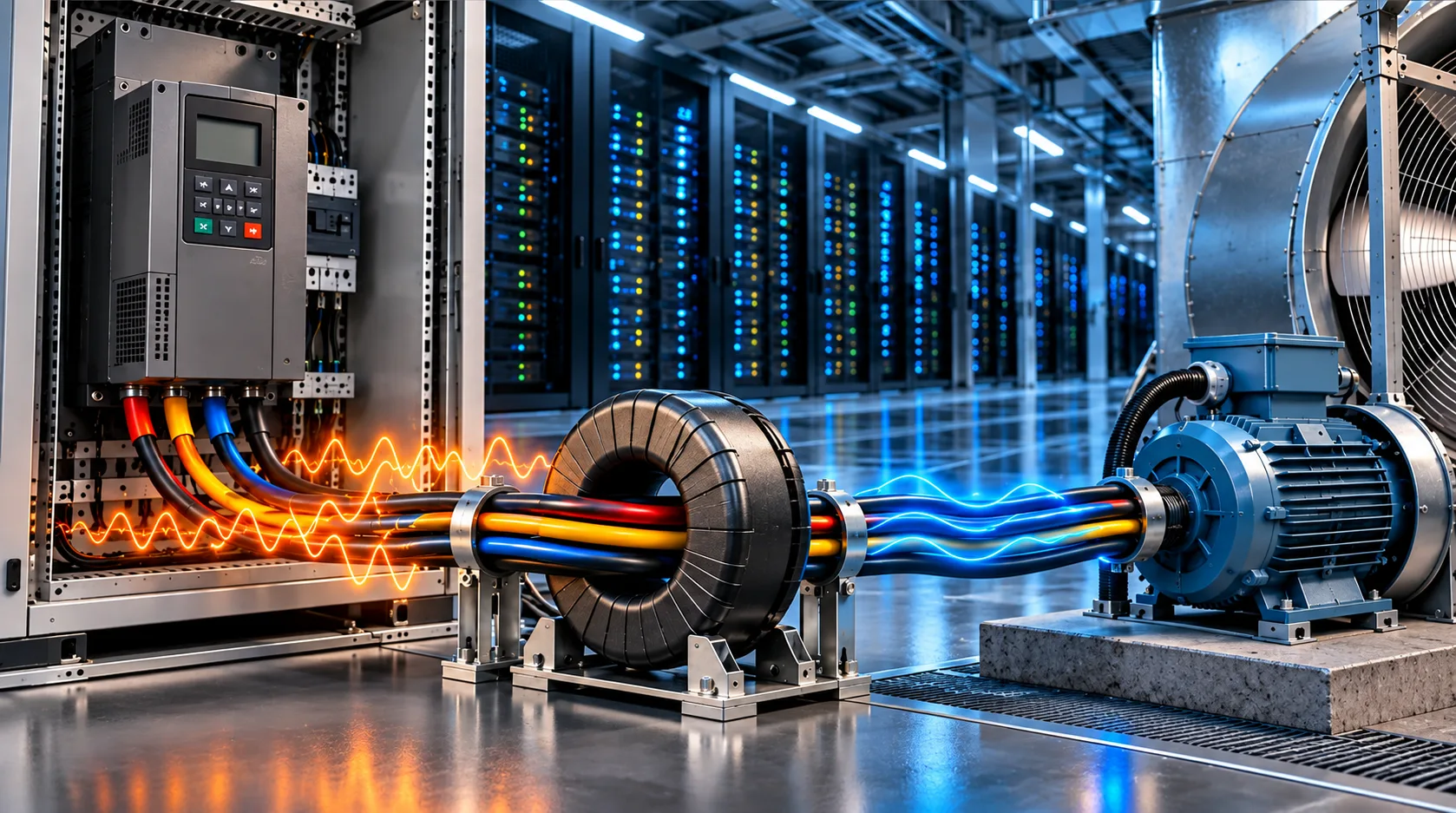
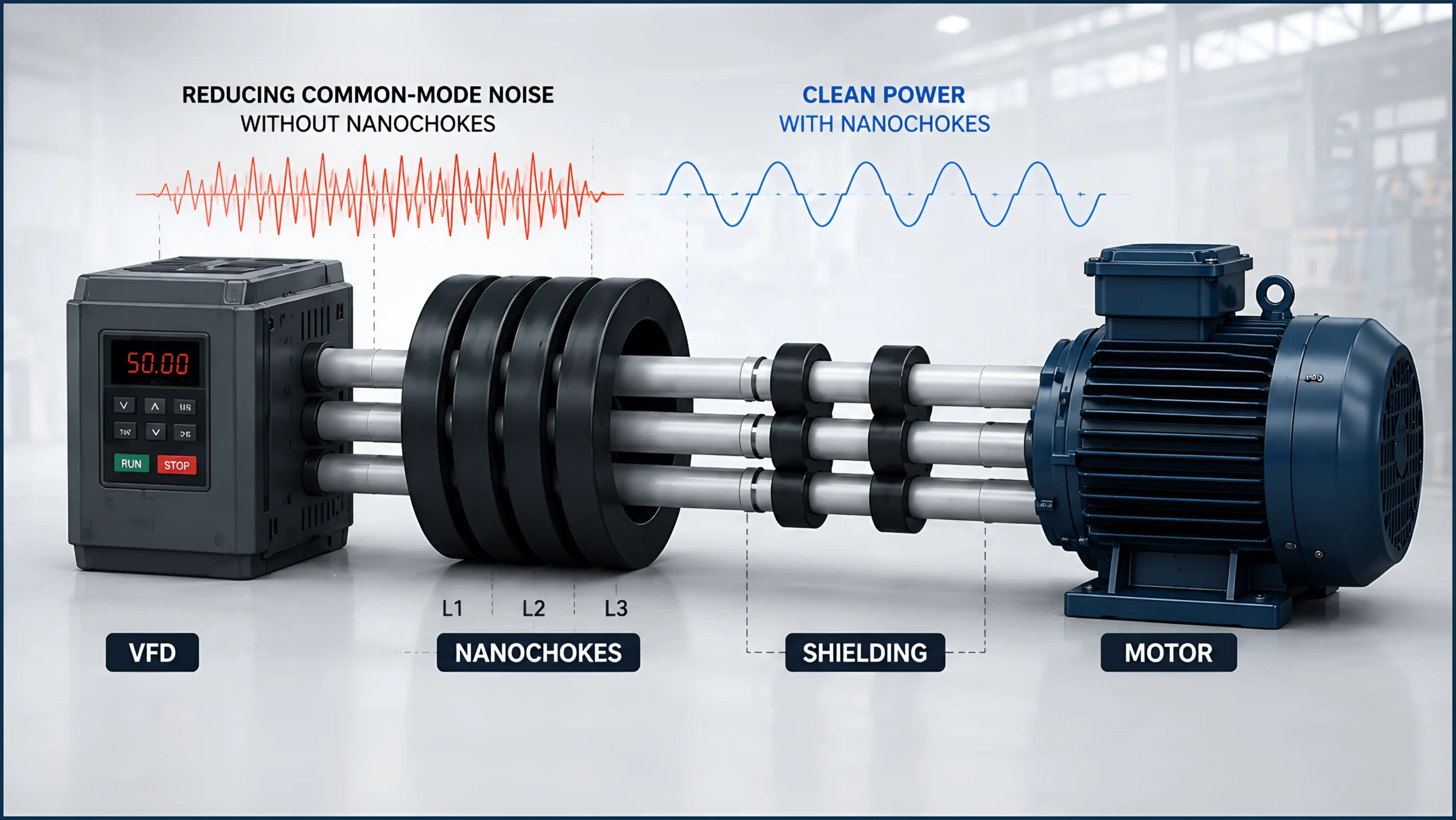
A VFD typically converts incoming AC to DC and then uses rapidly switched semiconductor devices to synthesize a variable-frequency output. The resulting pulse-width-modulated waveform contains fast voltage transitions. Those transitions can produce high-frequency components and common-mode currents that travel through motor cables, equipment frames and grounding paths.
Potential symptoms include interference with nearby controls or communications, nuisance behavior in sensitive electronics and additional electrical stress in some motor installations. Certain configurations may also develop shaft voltages or bearing currents. These effects depend on the drive, motor, cable length, grounding, operating conditions and system design they should not be assumed to occur in every VFD application.
3. Common-Mode Noise Is Not the Same as Harmonic Distortion
The terminology matters. High-frequency common-mode interference is associated with unwanted currents or voltages relative to ground, often driven by rapid switching. Low-order line harmonics, by contrast, concern distortion at multiples of the mains frequency and may require different mitigation approaches. A common-mode choke is not automatically a substitute for an input harmonic filter, line reactor, dV/dt filter or sine-wave filter.
Selecting the wrong component can leave the original problem unresolved. Engineers should first identify the disturbance, its frequency range, the current path and the performance target. Measurements and drive-manufacturer guidance are more useful than choosing a filter by appearance alone.
4. How Nanocrystalline Chokes Fit into the Picture
Nanocrystalline magnetic materials can provide high magnetic permeability and useful high-frequency magnetic characteristics, enabling compact choke designs for certain applications. In an appropriately designed common-mode choke, the magnetic core increases impedance to unwanted common-mode currents while allowing intended differential motor current to pass through the conductor arrangement.
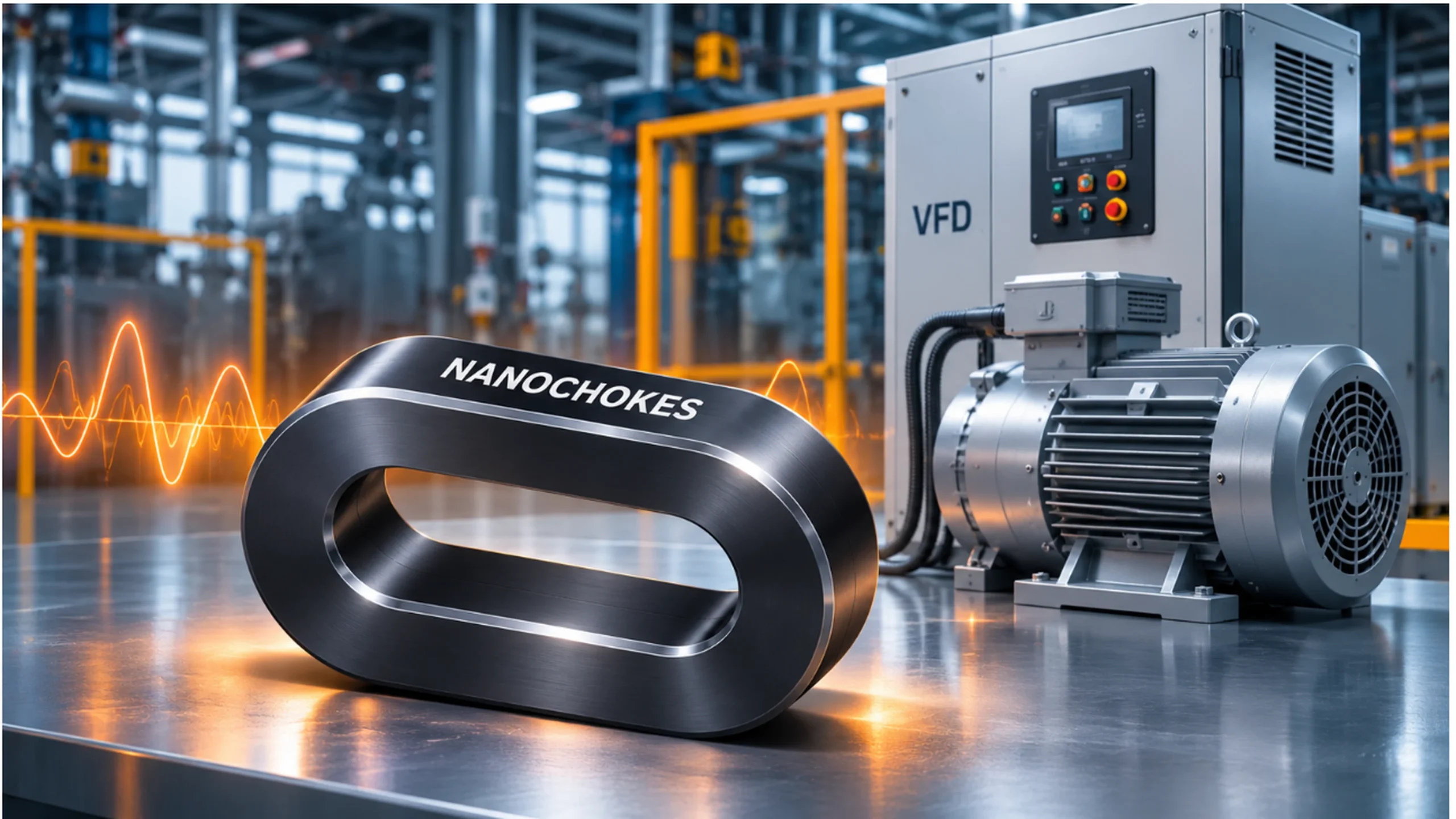
NanoChokes develops nanocrystalline choke solutions intended to help manage high-frequency electrical interference in suitable industrial applications. The practical outcome depends on the exact model, core dimensions, number and arrangement of conductors, operating current, frequency spectrum, temperature and installation location. A product should be chosen using its datasheet and application requirements rather than a generic claim of universal protection.
5. Five Practical Steps Toward More Reliable VFD Installations
Check the drive and cable arrangement
Review cable length, cable type, routing and the drive manufacturer’s maximum recommended motor-cable distance. Fast voltage edges and cable capacitance can contribute to reflections and electrical stress, especially in longer runs.
Use appropriate shielding and bonding
Properly terminated shielded motor cable and low-impedance bonding paths can reduce unwanted coupling and provide a controlled return path for high-frequency currents. ASHRAE specifically identifies grounding and shielding as foundational measures; filters supplement rather than replace good installation practices.
Separate sensitive signal wiring
Keep power and control cables appropriately separated and follow manufacturer instructions for shield termination and routing. This helps limit interference in sensors, controllers and communication systems.
Measure before specifying mitigation
Document the observed symptom and inspect relevant waveforms, common-mode currents or conducted noise with suitable instruments and qualified personnel. An evidence-based diagnosis helps distinguish EMI from mechanical faults, overheating, insulation issues or other unrelated problems.
Select and validate the right choke
Where common-mode attenuation is needed, review the NanoChokes model’s current capability, impedance or attenuation characteristics, thermal limits and mounting requirements. Confirm compatibility with the VFD, motor cable arrangement and applicable electrical standards, then verify the outcome after installation.
6. Where NanoChokes May Add Value
In suitable VFD-driven motor installations, a properly selected NanoChokes solution can be part of a broader EMI-management strategy. Its potential advantages include compact magnetic construction, high-permeability core technology and targeted attenuation of unwanted high-frequency currents. These characteristics can be valuable in industrial control panels, automation equipment and other electrically noisy environments.
However, no choke alone guarantees longer motor life, energy savings, compliance or elimination of bearing damage. Those outcomes require system-level engineering and, where relevant, testing. NanoChokes is best presented as an application-specific component that complements sound cable selection, grounding, shielding and other protective measures.
7. The 2026 Outlook: Reliability Through Better System Design
As factories adopt intelligent drives and condition monitoring, the next competitive advantage may come from treating electrical compatibility as part of reliability engineering from the beginning. That means specifying components early, coordinating between drive suppliers and panel builders, and validating performance under real operating conditions. It also means avoiding a one-size-fits-all approach to electrical noise.
For plant managers, maintenance engineers and OEMs, the question is no longer only whether a motor runs. It is whether the entire drive–cable–motor system operates predictably alongside the surrounding automation infrastructure. Thoughtful high-frequency noise mitigation can support that objective.
Frequently Asked Questions
What causes high-frequency noise in VFD motor systems?
Rapid semiconductor switching creates steep voltage transitions and high-frequency components. Cable capacitance, grounding and physical layout influence how unwanted currents propagate.
Can a nanocrystalline choke eliminate all motor problems?
No. A correctly selected choke may attenuate particular high-frequency currents, but it does not replace proper grounding, shielding, overload protection or diagnosis of mechanical and electrical faults.
Are common-mode chokes and harmonic filters interchangeable?
No. They address different electrical phenomena and frequency ranges. The correct choice depends on the measured problem and system requirements.
When should an engineer consider NanoChokes?
Consider an application review when high-frequency common-mode interference is identified or anticipated in a suitable VFD or automation installation. Selection should follow the specific datasheet and drive manufacturer’s guidance.
Do NanoChokes products guarantee energy savings?
No. Energy savings from variable-speed operation depend on the process and drive application. A choke’s role is primarily related to specified electrical noise mitigation, not a guaranteed reduction in energy use.
Explore NanoChokes for Your Application
Working on a VFD-driven motor, industrial panel or automation project? Share your drive model, operating current, motor-cable configuration and technical challenge with the NanoChokes team. We can help you explore whether an appropriate nanocrystalline choke solution belongs in your system design.
Explore solutions: www.nanochokes.com | Email: reach@nanochokes.com
References and Further Reading
- U.S. Department of Energy Motor Systems
https://www.energy.gov/cmei/ito/motor-systems - ABB What Is a Variable Speed Drive?
https://www.abb.com/global/en/areas/motion/drives/expertise-technology/what-is-a-variable-speed-drive - Plant Engineering Next-gen VFDs: Experts Reveal the Trends Shaping Motor Control (Sep/Oct 2026)
https://embed-rech-01.dialog.cm/wtwhmedia/docs/plant_engineering_september_october_2026 - ASHRAE Handbook Motors, Motor Controls, and Variable-Frequency Drives
https://handbook.ashrae.org/Handbooks/S24/IP/S24_Ch45/S24_Ch45_ip.aspx - DigiKey How to Select Cables for Reliable VFD Motor Control (Mar 2026)
https://www.digikey.com/en/articles/how-to-select-cables-for-reliable-vfd-motor-control-and-sensor-feedback
Editorial note: Information is educational; technical performance depends on the selected product and installation. Featured image is an illustrative visual, not an installation diagram.